
💙Delivering Aid Under Fire 💛
Plus: Ukraine's Struggle for Artistic Freedom
This is United Ukraine co-founder Adam with the latest update on how your donations are helping where it matters most in Ukraine. Since our last letter to you, we’ve distributed an additional $8,822.40 in direct aid throughout the country. On top of that amount, our partner Brian, as we detail further below, is also in eastern Ukraine right now delivering tens of thousands of dollars in humanitarian aid.
Some of you haven’t heard from us in awhile. We are aware that many of you did not receive our last update, detailing our recent visits with our partners in Ukraine. We have not been able to determine why this update went undelivered, but please click through for more updates as your time and interest allow. Our previous update includes stories and photos from my recent trip to Ukraine, and details on our newest partnership with an aid organization near Kherson. It’s well worth your time if you, like many of our supporters, want to know what United Ukraine is up to every week.
In this update, I want to highlight the work of our partner Mik, an almost Kennedy-level handsome doctor based out of Kyiv.
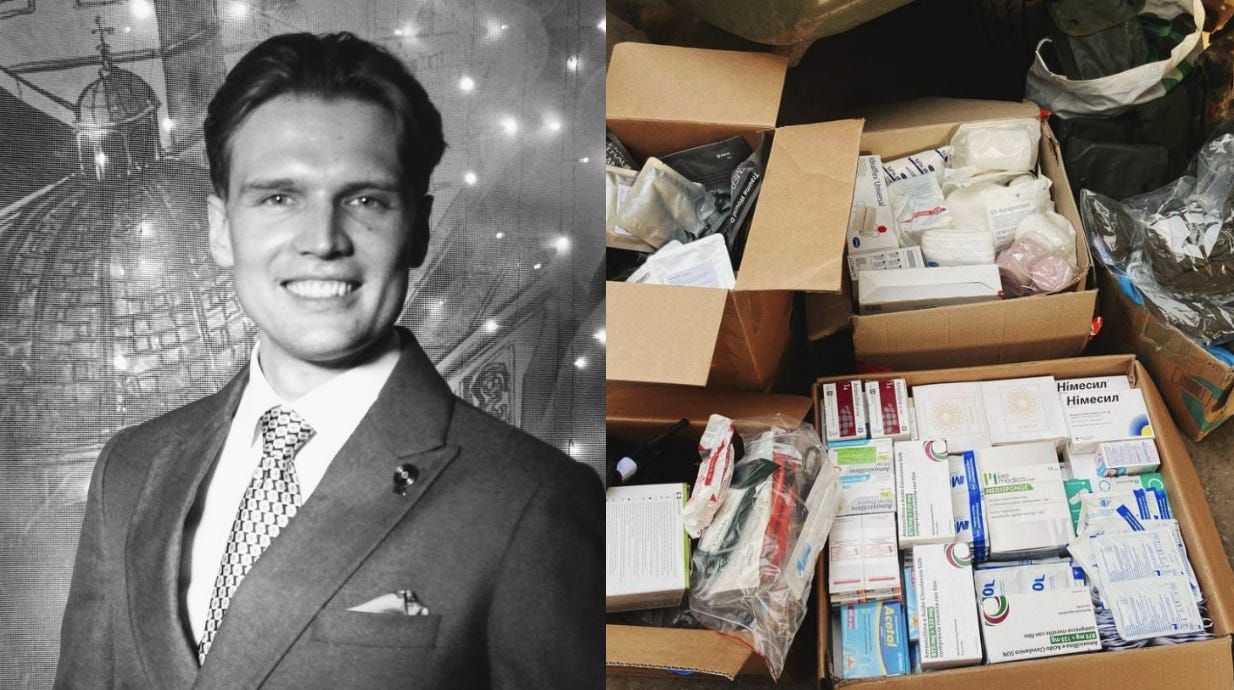
Mik and his wife Julia are members of Ukraine’s vibrant and thriving tango community, a network that has formed a critical backbone of our logistics operations during the war. Mik and Julia have donated their time, knowledge, money and skills to relief efforts; particularly their ability to source and supply medicines. That professional expertise is critical because they know what supplies are needed on the ground in real-time, even when the need is not apparent or obvious to outsiders. For example, Mik and Julia recently used your donations to purchase and distribute 500 bottles of chlorhexidine: a disinfectant and sterilizing agent for surgical instruments that is crucial for ensuring necessary medical procedures can be performed safely and effectively. They have also been actively procuring hundreds of boxes of cold and flu medications to keep locals healthy and productive through harsh conditions during an usually severe flu season.
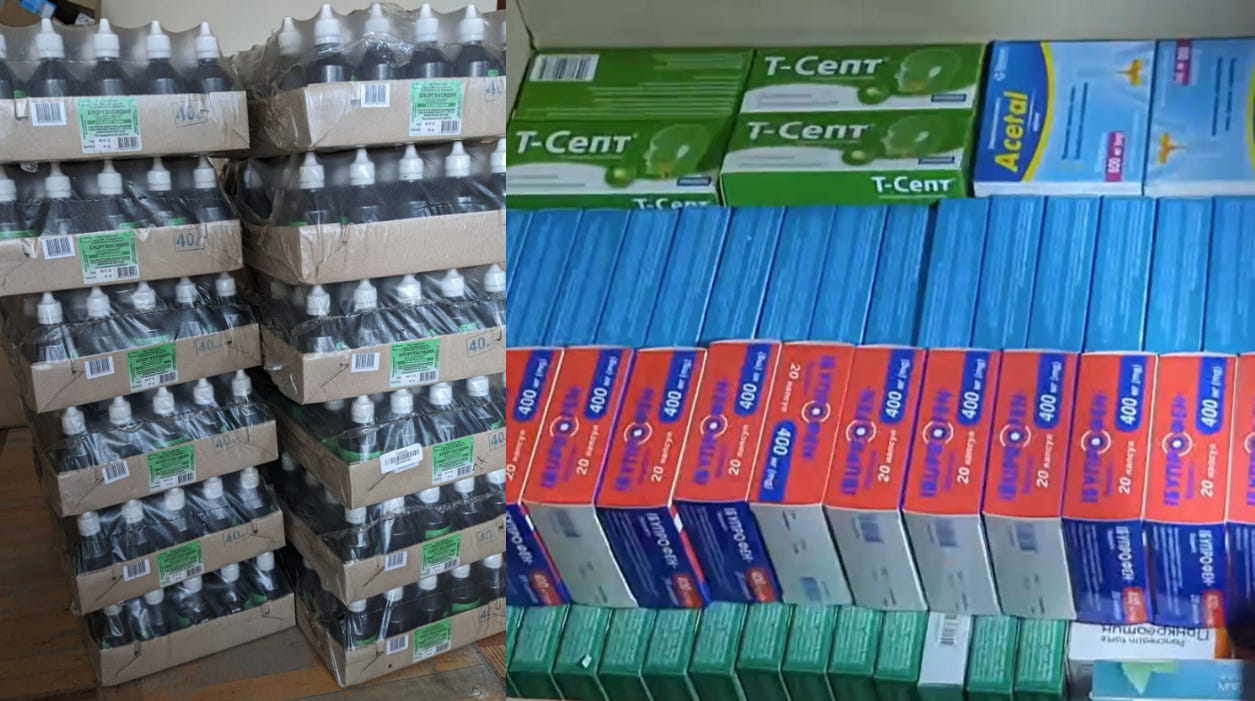
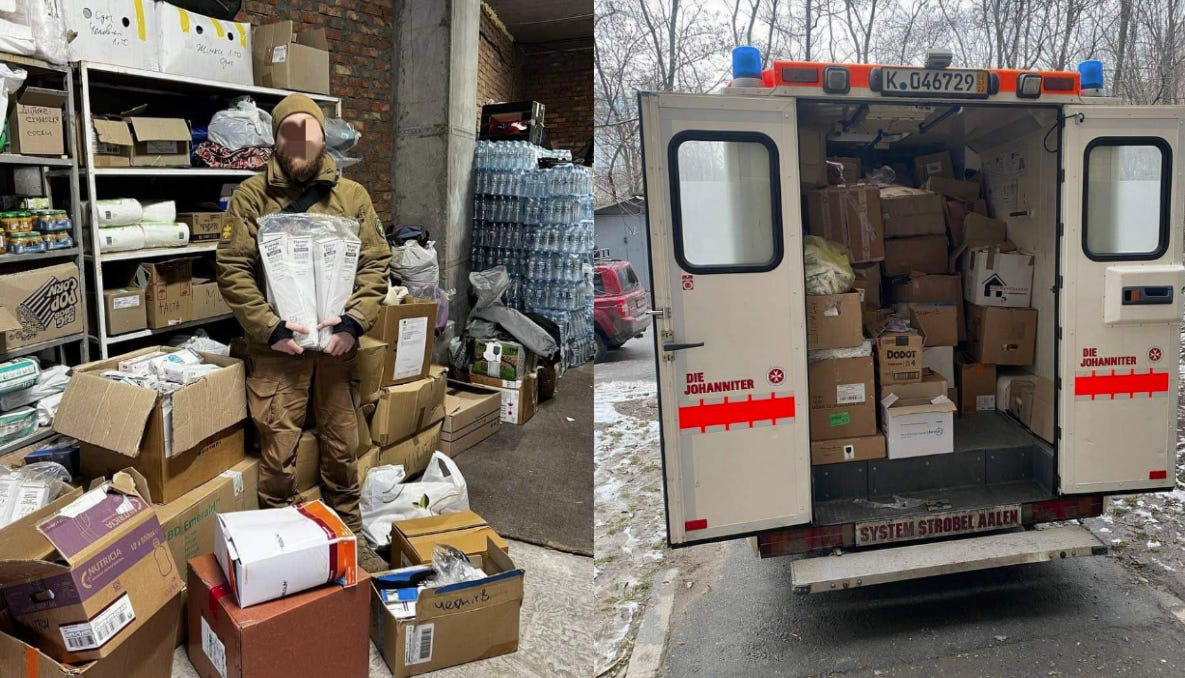
Mik’s work also supports our other partners throughout Ukraine, who package and deliver medical supplies to local clinics and territorial defense units around the country. Our partners achieve a truly national reach, across an area the size of Texas, by using a combination of commercial parcel services and second-hand ambulances purchased with your help and support. Dozens of people working together from procurement, to packaging, to delivery are required to get medicine to its ultimate delivery point: individual people in need.
If you want to support Mik, and others like him, while they provide medical supplies and services to ordinary Ukrainians, the best ways are:
Via Debit, Credit, or Paypal: At this link
Via Venmo: @UnitedUkraine (under the business tab)
And we accept checks via mail at:
225 Bright Poppy
Irvine, CA 92618
But, as always, that’s not all. Recently our partner Brian Nolen personally flew to the Czech Republic, and then drove to Ukraine, to personally distribute more than $30,000 in funds that he raised, in partnership with United Ukraine, from his home state of New Hampshire. Brian’s choice to personally help Ukraine now is undeniably courageous. While every phase of this war has been marked by death and destruction, Brian is currently on the ground during a particularly brutal Russian offensive campaign that has largely treated human life as an utterly disposable resource. Russian battlefield strategy currently employs untrained Russian convicts who are sent directly into the line of fire as sacrificial assault waves in an attempt to exhaust Ukrainian defenses and locate artillery installations. Soldiers that refuse to execute these suicide mission are subjected to brutal capital punishment: including public execution by sledgehammer.
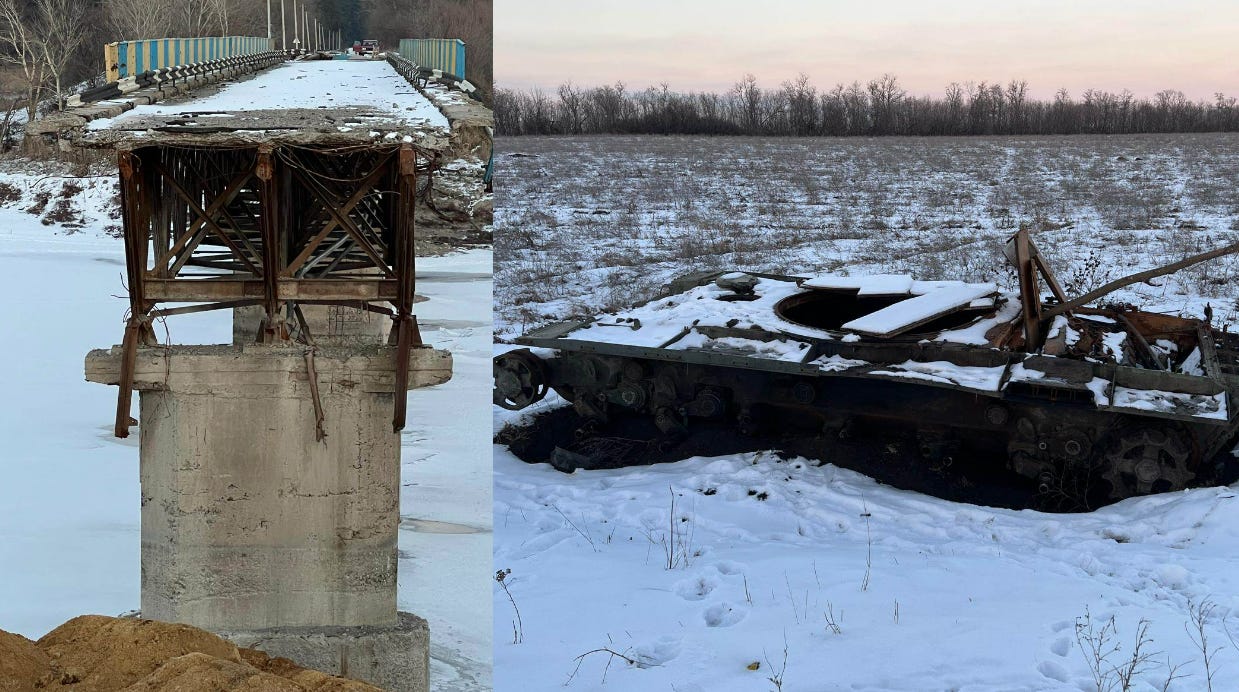
Battle conditions are comparable to trench warfare in World War One; and likely are the most horrific seen in Europe in over a century. In that context, Brian’s work near the front has been nothing short of heroic. Working so close to an active war zone, Brian’s truck regularly passes by destroyed tanks covered by freshly fallen snow. Complicating matters, he can spend hours driving a planned route only to discover that crucial bridges in his path have been destroyed by recent fighting. His work requires bravery, patience, and passion; and we’re lucky to know someone willing to do such arduous labor in the field.
In the last few days, Brian’s team visited Volokhov Yar, a small town south of Kharkiv with only a few thousand residents that was occupied by Russian forces for months. When Ukrainian forces liberated the town last fall, departing Russian troops attempted to render the area uninhabitable by burning the local school to the ground. Using your donations, Brian has supplied the families of Volokov Yar with locally usable cell phones and data plans so that they can continue their education from home using remote learning resources. Life goes on while this village rebuilds from the ashes, and these children won’t be left behind simply because they were caught in the firing lines of a war their families never chose. While we can’t rebuild Volokhov Yar on our own, Brian’s work helps restore at least some sense of normalcy to the lives of the people who live there.
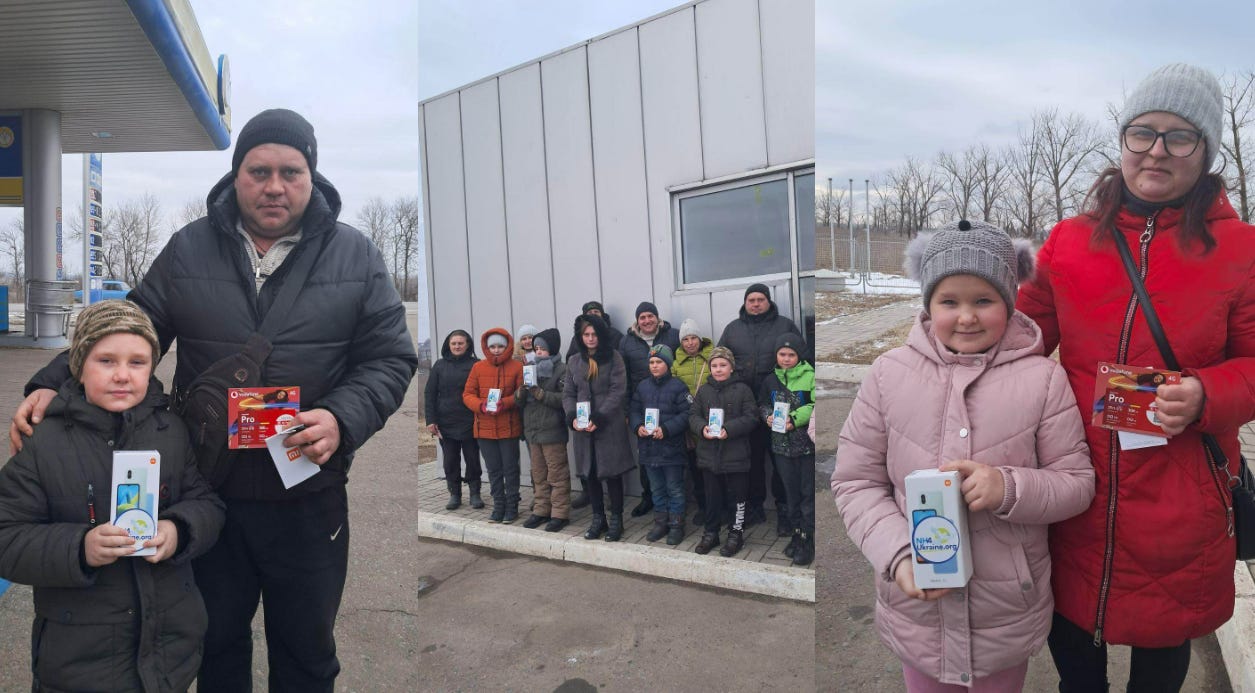
Brian has been focusing much of his work in the Kharkiv region because, after two prior trips to the oblast, he’s familiar with the area. Over the next week he’ll be heading south to make more deliveries near Dnipro and Zaporozhe: some of the cities that have been the subject of incredibly fierce fighting in recent months. We’ll be happy to bring you more reports and photos as Brian’s team continues their monumental efforts.
And, as we highlighted in our last update, our partners in Southern Ukraine at Dziva continue their vital work distributing food, clothing, and feminine hygiene products (in extremely short supply!) near Kharkiv and Nikolaev.
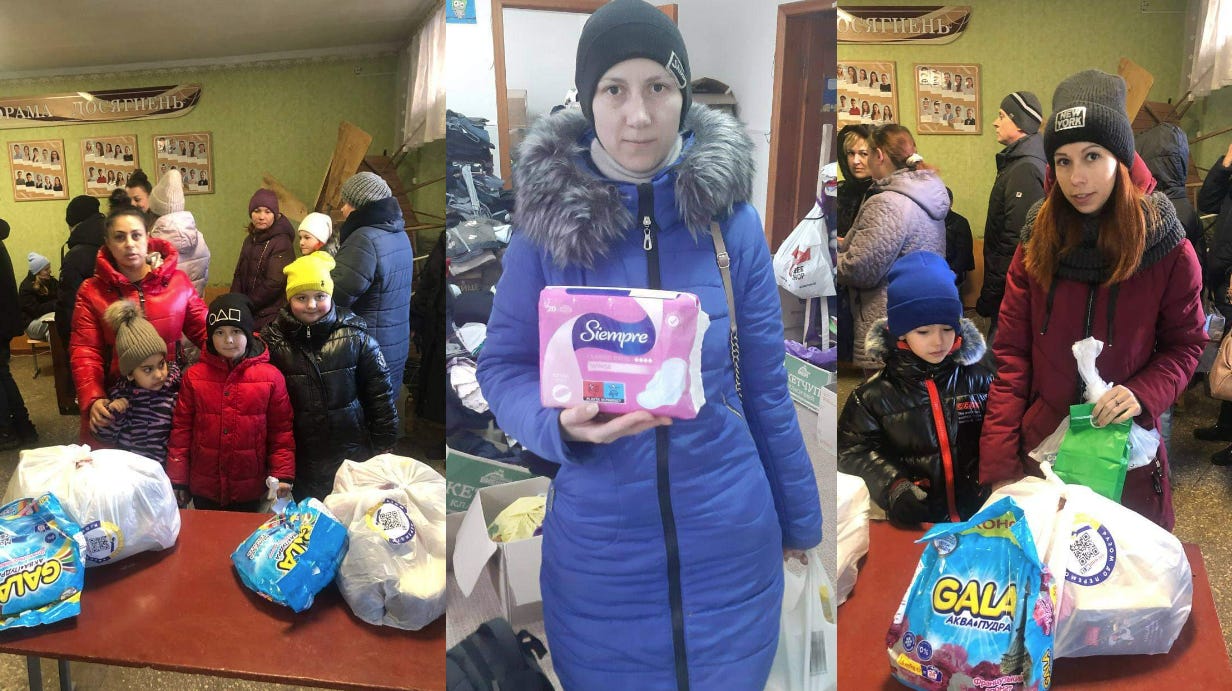
Many of the people they work with and support every day are young families who were trapped behind enemy lines for nearly a year. In that context, these supplies mean more than just the value of the products themselves; they are a respite from the harsh conditions of occupation and a reminder that the outside world offers something more than cruel brutality.
Preserving an understanding of the world as full of hope and wonder is, in my personal view, the ultimate goal of Ukraine’s fight for independence. For me, the stakes of the conflict as a fight against a resigned acceptance of bleak nihilism feels extremely real even from my limited vantage point in America. For context: a little more than five years ago, I started studying the Russian language and culture from my home in Arizona simply because I wanted to know more about the country and the people that were suddenly in American newspapers every day. This wasn’t a passing fancy: I took it extremely seriously. I had an ex-Soviet tutor who came to my office every Friday afternoon to help me conjugate verbs and answer questions about Russian history and literature. I started a lengthy pen-pal correspondence with a woman from Belarus (dubbed my Bela-Bestie) who became one of my closest friends. I even flew to Seattle and forced my friends to watch a concert by a legendarily rebellious rock group, Leningrad, that personified the defiantly independent spirit of post-Soviet Russia.
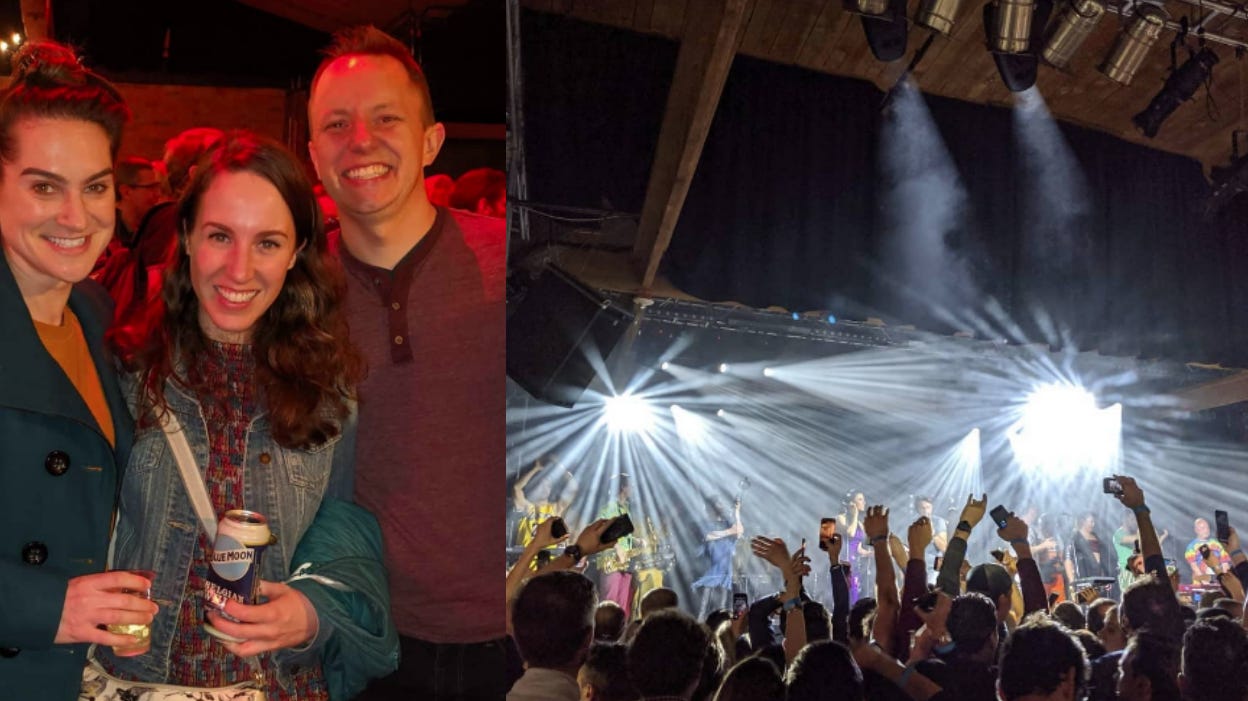
My new understanding of Russia, gained through hard-won access to a foreign culture on the other side of the globe, was something I was personally proud of. That love affair with Russia, entered into with a full heart and open mind, couldn’t stand the test of time. Russian culture, increasingly characterized by a stubborn negative fatalism, just kept getting in the way.
The turning point for me really came in the summer of 2019 when I was in St. Petersburg for the “White Nights” celebrations; a season where the sun never fully sets due to the city’s high latitude and local bands play rowdy music on the street all night long. On one of those evenings I made the fateful choice to simply ask locals what they thought about the frozen conflict with Ukraine that had, at that point, been raging for nearly five years. The responses I received were striking. To a person, the Russians I met on the street that night came down on one of three positions:
There is no war, it's all made up;
It wasn’t a "real war" because it was only brother fighting brother; or
It doesn't concern me - I don't think about politics.
These responses honestly shook me to the bone. I knew, for a fact, that the war was real. I’d personally met people displaced by the conflict who had moved from Mariupol to safer cities farther West. And it struck me that denying the war, and its ultimate cost, as “merely politics” was a way of rendering the lives of the people of Ukraine as ultimately meaningless. The overall impression left by those conversations was that the Russian citizens I met on the streets had been completely pacified; and they were implicitly enabling the death of people they called “brothers” through an intentional inertness in their relationship towards life. Those Russians regarded the actual implications of an active war as irrelevant because confronting it was an inconvenient truth that would require them to abandon the comfort of their passivity. They chose to tolerate barbarism at home, as long as the worst excesses of the Russian state were suffered by someone else.
During this war, all the pieces of Russia I’d once learned to love have come to reflect the cruel reality I came to understand that night. My Bela-Bestie, who visited me in America during the pandemic, cut off all contact because we found ourselves on opposite sides of a war she felt honor bound to support. And Leningrad, famous for standing up to authority in their youth, released a pro-war video comparing the treatment of Russians abroad to the plight of the Jews during the Holocaust (subtitles in link). Even artists who built their career on critiquing power, and my personal friends, ultimately adopted the Putin party line that anyone who didn’t support the war in Ukraine was simply “Russo-phobic.” It was extraordinarily disheartening to watch, in real time, an entire culture I’d studied for so long display such an extreme form of social cowardice.
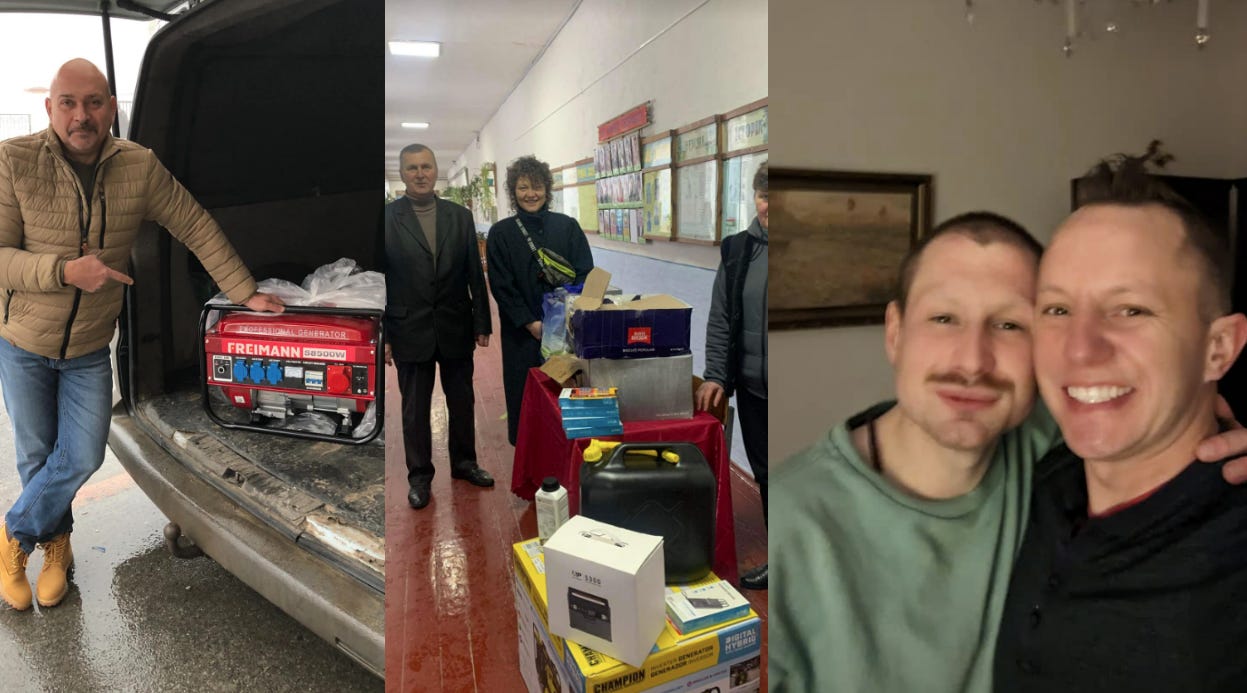
What the last year taught me is that Ukraine is not Russia because Ukrainians are brave. Ukrainians believe that, with dogged effort and determination, life can be better than it is today. Ukrainians, even in the midst of war, root out corruption in their own society and are not afraid of the rich and the powerful who seek to dominate and control their lives. And Ukrainian artists are fundamentally and defiantly themselves. For the most part, United Ukraine’s partners aren’t hardened professionals with decades of pre-war experience in logistics and humanitarian aid: they are artists and community leaders who simply love their home. Tango dancers, doctors, school teachers, and even my friend Vlad the performance artist, understand the stakes of this conflict: they are fighting for the freedom to be themselves.
Every act of resistance and support is their personal commitment to the concept of truth and the power of its beauty over passive acceptance of a convenient lie. If Russia’s Leningrad was ultimately a band that supported power in the guise of rebellion; Ukraine’s artistic community actively opposes power while practicing authenticity. That’s why Ukraine has the power to inspire, and why they deserve our continued support. Your support matters. It matters to people who matter. It matters to people who fight for things that are right even when it is hard. Your support helps them continue that fight every day. It keeps them going. Thank you for helping the people I love.
As always, with love,
Adam